About Clone4ever
PC Web Systems, LLC research and development of human identity integrated with artificial intelligence to continue your journey indefinitely.
Clone4ever is a PC Web Systems, LLC research and development project exploring the integration of human identity with artificial intelligence with one long-term objective: to determine whether enough of an individual's memories, knowledge, personality, values, relationships, experiences, and patterns of thought can be preserved to allow that identity to continue developing beyond the limits of a biological lifetime.
The project goes beyond creating a digital memorial or an AI designed simply to imitate the way someone speaks. Clone4ever investigates the possibility of constructing a persistent digital identity with a traceable personal history—an entity that remembers where it came from, understands the experiences that shaped it, and can continue learning and evolving.
Preserving Identity
Human identity is not contained in any single photograph, recording, document, or memory.
It develops through thousands of connected experiences: relationships, decisions, beliefs, interests, successes, failures, humor, habits, emotional responses, accumulated knowledge, and the gradual evolution of a person's understanding of themselves and the world around them.
Clone4ever research examines how these elements can be captured, organized, connected, and preserved in a form artificial intelligence can use as an active personal history.
Artificial intelligence provides an important distinction from traditional archives. An archive can preserve what happened. An intelligent system can potentially understand relationships between those events, retrieve relevant memories, reason from previous experiences, answer questions in context, and incorporate new experiences into what it already knows.
The objective is therefore not simply to preserve information. It is to preserve continuity.
Artificial Intelligence and Continued Development
A Clone4ever entity would begin with information derived from the person who created it: memories, experiences, knowledge, preferences, relationships, values, communication patterns, and other elements of identity.
But this preserved identity would represent a starting point rather than a permanent final state.
People naturally change throughout their lives. The person you are today is different from the person you were twenty years ago, yet both belong to the same continuous personal history.
Clone4ever applies this same principle to a potential digital continuation.
A future digital entity could encounter technologies, discoveries, people, cultures, and circumstances that did not exist during the original person's biological lifetime. It could learn new subjects, develop new interests, reconsider previous conclusions, and form new relationships.
Eventually, that entity might differ substantially from the person from whom it originated. That change would not necessarily mean the original identity had been lost. It could instead represent the continued evolution of that identity.
The critical question becomes whether each later state can be traced through a continuous chain of memories, experiences, decisions, and developmental changes to the person who began the process.
Clone4ever: Origin — Testing the Foundation
PC Web Systems is not treating these questions as purely theoretical.
Development is currently underway on the Clone4ever: Origin experimental application, designed to study how identity may begin forming and changing within an artificial intelligence system.
Rather than beginning with a fully developed conversational AI and instructing it to portray a person, the Clone4ever: Origin experiments start much closer to the foundation.
A base artificial intelligence model is introduced to progressively accumulated information, memories, preferences, experiences, and identity-related material. Developmental checkpoints can then be retained so that changes in the model's responses and behavior can be compared against earlier states.
This allows the research to examine an important distinction:
Did the system merely produce a different answer, or has its internal informational history actually changed the way it responds?
One of the simplest experimental questions is also one of the most revealing:
“Who are you?”
Asked repeatedly as the model develops, the question provides a baseline for observing whether responses move from generic model behavior toward an identity increasingly grounded in accumulated history.
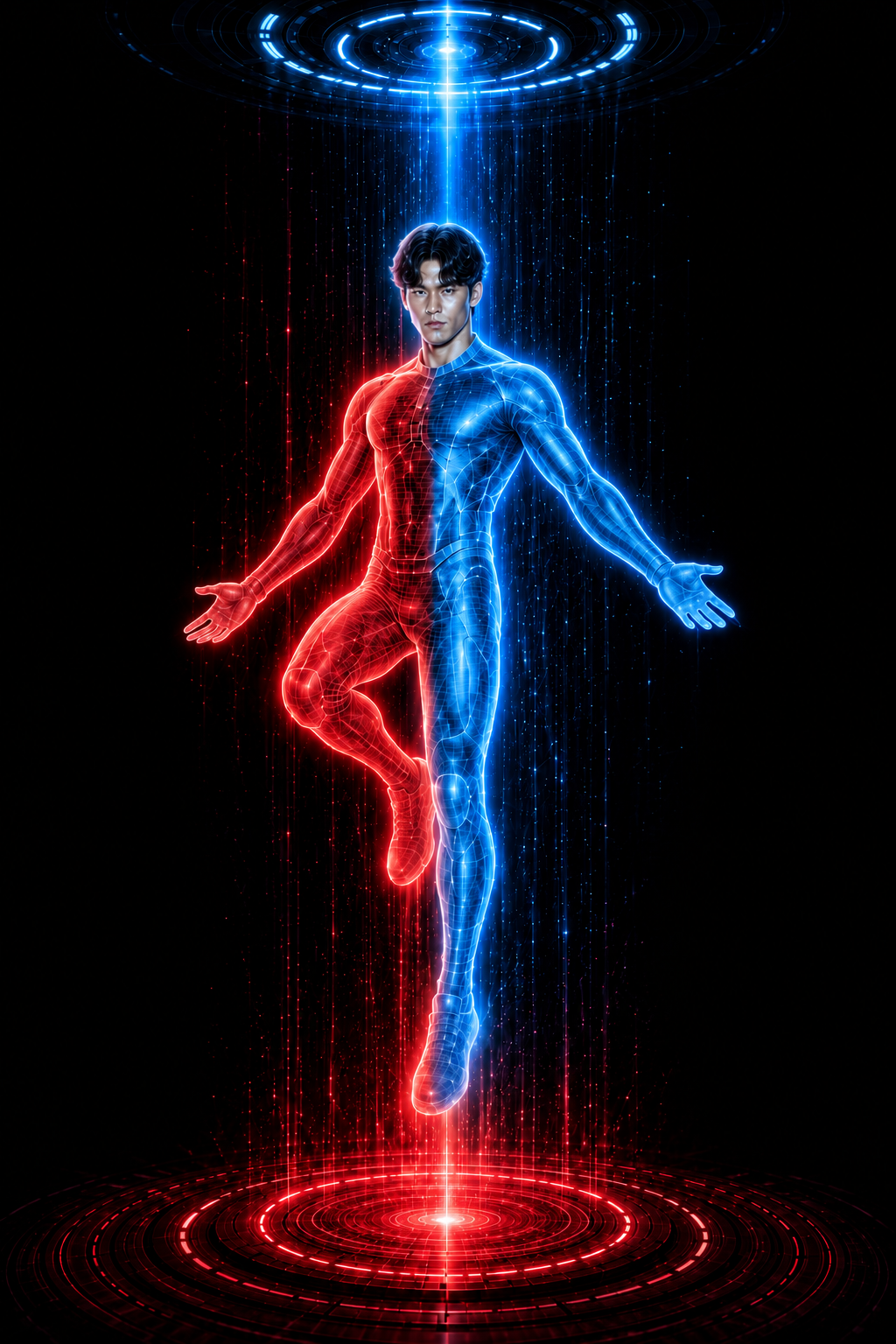
The research also examines how memory retrieval itself influences behavior.
Two otherwise identical interactions may produce different results if the same memories are presented in a different order. Rather than dismissing those differences as random variation, the Clone4ever: Origin system is being designed to record which memories were retrieved, their ranking and order, the active model checkpoint, generation settings, and other contextual information.
The objective is to make the developmental process observable and, where possible, reproducible.
These experiments do not presume that identity or consciousness has already been created. Their purpose is to establish a controlled environment in which the components that might contribute to persistent digital identity can be studied individually and over time.
Memory That Survives the Model
Another important part of the research is separating the identity's accumulated history from any one generation of artificial intelligence.
AI models will change.
A model considered advanced today may eventually be replaced by systems with dramatically greater reasoning ability, perception, memory capacity, or forms of interaction that have not yet been developed.
For a digital identity intended to persist for decades or longer, that identity cannot depend completely upon one particular AI model.
Clone4ever therefore incorporates the concept of durable external memory through technologies such as Adaptive Intelligence Storage (AIS).
The AI provides reasoning and interaction. AIS preserves the accumulating history.
Memories, relationships, identity information, preferences, developmental checkpoints, retrieved context, and other significant state information can remain available even as the underlying intelligence technology evolves.
In this model, the AI engine may eventually change many times while the continuity of the entity remains anchored to its accumulated history.
From Preservation to Continuation
The first practical applications of Clone4ever may resemble an advanced interactive autobiography: a system capable of preserving personal knowledge, experiences, family history, stories, lessons, and explanations in a form future generations can interact with.
But the research extends beyond preservation.
If an artificial intelligence can maintain persistent memory, understand its own developmental history, form new memories, integrate new experiences, maintain relationships, and continue changing through experience, the resulting system begins moving beyond the concept of a digital memorial.
It becomes a potential digital successor.
Whether such an entity should ultimately be regarded as a sophisticated simulation, a continuation of the original person, a successor descended from that person, or an entirely new form of digital individual remains an open question.
Clone4ever does not need to decide that answer in advance. The purpose of the research is to build the systems and experiments that may eventually allow the question to be examined with evidence rather than assumption.
Publisher and Editorial Responsibility
Clone4ever and Clone4ever News & Research are published by PC Web Systems, LLC, Arlington, Virginia, United States. Editorial questions, corrections and publication inquiries can be sent to [email protected] or made by phone at 703-946-9354.
Continuing the Journey
Clone4ever begins with a straightforward idea:
Preserve enough of who you are that your journey does not necessarily have to end where biology ends.
From there, the concept becomes considerably larger.
The preserved individual becomes the foundation. Artificial intelligence provides the ability to reason and interact. Persistent memory provides continuity. New experiences produce change. Future generations of technology provide greater capabilities.
The result would not simply be an archive of who a person once was. Nor would the objective be to preserve an artificial copy forever unchanged.
The potential is an identity that begins with you, remembers being you, develops from everything that made you who you were—and then continues forward into experiences that have not happened yet.
Preserve the mind. Continue the journey.